

Adding properties isn’t the same as scaling property management operations. Real scale means growing a portfolio while systems, workflows, and decision-making keep service consistent without routing every issue through the owner. Automation and centralized tools help make that growth manageable.
A larger portfolio may seem to require more people. But if routine tasks rely on manual follow-up or scattered information, adding staff alone won’t remove the bottlenecks. Build repeatable processes that support teams as responsibilities and property data grow.
This article explains what scaling a property management business means in practice and how to spot operational strain. You’ll learn how to systematize recurring work, coordinate tasks across a portfolio with software, and match growth to operational capacity. The focus is commercial property management in Poland, with practical ways to build clarity and control as your business expands.
Key Takeaways
- Map recurring communications and administrative work to identify processes that can follow consistent, repeatable workflows.
- Match portfolio growth to team and system capacity, and watch for service strain before it becomes a wider operational problem.
- Use software automation to make task ownership, follow-ups, and escalation paths easier to manage across properties.
- Centralize portfolio information and workflows to improve coordination and make operational patterns easier to spot.
- Build a business that can grow by developing independent decision-making alongside efficient systems, not by adding properties alone.
1. Automating routine communications and tasks
Start by automating high-volume, repeatable processes: request intake, routine status updates, onboarding steps, and approval follow-ups. These tasks recur across properties, so clear workflows help teams handle them consistently, regardless of who manages each building.
Start with a practical review: list the tasks completed in the previous 24 hours, then identify which could be eliminated or handled through technology. For example, if staff repeatedly acknowledge requests, send the same progress update, or chase an approval, map each step and assign an owner, trigger, and next action. This reveals where automation can reduce manual workload without removing staff oversight.
Request intake is a strong starting point. A structured system can collect request details, classify issues, and create work orders in one operational platform. AI-based intake can apply consistent emergency criteria, escalation rules, and routing protocols across properties. Staff can then review exceptions and coordinate responses instead of sorting every message from scratch.
Set explicit thresholds for follow-up. For example, a workflow can notify a regional director when an approval has remained open for 48 hours. Automatic escalation flags stalled processes before they depend on someone noticing a delay. Define who receives the alert, what information they need, and how the next action is recorded.
Onboarding also benefits from repeatable workflows. Break it into stages, such as collecting property details, assigning responsibilities, setting up communication channels, and confirming that operational records are ready. A shared sequence helps staff follow the same process for each new property and makes incomplete steps visible before the portfolio grows further.
Integration matters because disconnected tools lead to duplicate entry and fragmented communication. Connect systems and processes where appropriate, then establish clear channels for collaboration and data sharing between property managers and back-office teams. For example, staff shouldn’t need to re-enter a request before the responsible team can see its status.
Consistent communication supports tenant experience and retention by clarifying ownership and next steps. Use defined templates for routine acknowledgements and progress updates, while routing complex or sensitive issues to a person. Review recurring requests and response patterns across properties: repeated questions may show that instructions or workflows need improvement.
Keep staff involved in exceptions, judgment calls, and relationship-sensitive conversations. Automation works best when each workflow has a clear trigger, responsible role, escalation path, and completion record. These controls make efficiency measurable and help teams refine processes as portfolio needs change.
2. Operational challenges as property portfolios grow
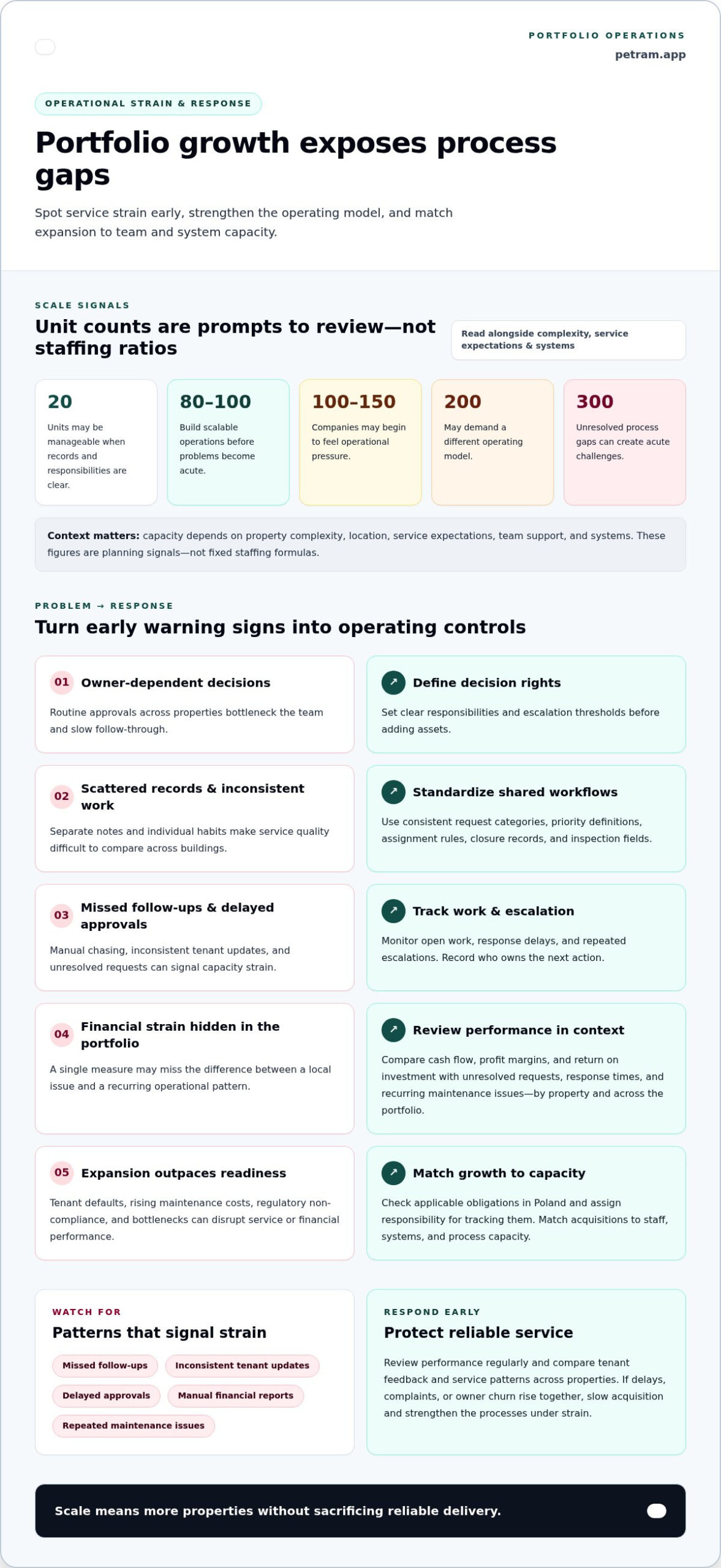
Operational strain often appears before a portfolio reaches a crisis point. Companies may feel pressure around 100 or 150 units, while 200 units can demand a different operating model. By 300 units, unresolved process gaps can create acute challenges. These thresholds are planning signals, not fixed staffing ratios.
One property manager’s efficient capacity depends on property complexity, location, service expectations, team support, and systems. A portfolio of 20 units may be manageable when records and responsibilities are clear, but scattered information and owner-dependent decisions can overwhelm a smaller operation. Track open work, response delays, and repeated escalations to see whether workload is exceeding capacity.
Missed follow-ups, inconsistent tenant updates, delayed approvals, and manually assembled financial reports can signal that self-management has outgrown its structure. If the owner must approve routine actions across several properties, for example, that bottleneck slows the whole team. Define decision rights and escalation thresholds before adding assets.
Standardize maintenance, tenant communication, and inspections with shared processes. Use the same request categories, priority definitions, assignment rules, and closure records across properties. Create an inspection template with consistent fields, then record findings and follow-up actions in a central system. Managers can then compare service quality without relying on separate notes or individual habits.
Track portfolio performance through cash flow, profit margins, and return on investment. Pair those financial measures with operational indicators such as unresolved requests, response times, and recurring maintenance issues. Review results by property and across the portfolio. A recurring delay at one building may be local; the same pattern across buildings may point to a process problem.
Link expansion decisions to operational readiness. Tenant defaults, rising maintenance costs, regulatory non-compliance, and bottlenecks can disrupt service or financial performance. In Poland, review each property’s applicable obligations and assign responsibility for tracking them. Match new acquisitions to staff, systems, and process capacity instead of treating added units as growth by themselves.
Protect service quality with regular performance reviews and tenant satisfaction surveys. Compare feedback and service patterns across properties, then investigate changes early. If delays, complaints, or owner churn rise together, slow acquisition and strengthen the processes under strain. Growth should mean more properties without sacrificing reliable delivery.
Build scalable operations before problems become acute, around 80 or 100 units. As scaling property management operations continues, use early-warning indicators to decide when to adjust staffing, responsibilities, or workflows. Review the portfolio’s financial and service measures together, then set a clear readiness gate for adding properties. That turns expansion into a managed decision, not a test of how much the owner can personally absorb.
3. Property management software and task automation
A growing property management company needs software that supports its operating model. Start by mapping administrative tasks from receipt to completion. For example, document how a maintenance request becomes an assigned task, who reviews it, and where the outcome is recorded. This reveals duplicate entry, unclear ownership, and handoffs that consume staff time.
Automate repeatable administration when the rules are clear. A system can organize incoming requests, assign tasks, track status, and retain a record of completed work. For recurring processes, define the trigger, responsible role, required information, and completion condition. Keep exceptions visible so staff can handle unusual cases without searching through inboxes or spreadsheets.
Use automatic escalation rules to flag stalled processes. An unassigned task, an approval awaiting action, or a maintenance request without a status update can trigger a notification to the responsible manager. Set the escalation path in advance: identify the first owner, the next decision-maker, and the information each needs. This makes intervention part of the workflow rather than a test of someone’s memory.
Maintenance tracking is more useful when linked to vendor coordination. A property manager can record the request, assignment, progress, and outcome in a shared operational view. Review maintenance requests, response times, and escalation patterns across properties. Repeated delays involving one vendor or request type may reveal a process issue that individual task records hide.
Software should reduce administrative effort without obscuring responsibility. Assign a named role to review exceptions, correct incomplete records, and confirm that tasks reach their intended outcome. Automation can route an approval, for example, while a manager retains authority over the decision. Clear accountability helps protect service quality as the workload grows.
Choose systems for the portfolio you expect to manage, not just its current size. Assess how a platform represents properties, tasks, vendors, and reporting needs, then test a representative workflow before wider adoption. This helps you determine whether it can support expansion without rebuilding workflows each time the business grows.
A 10-unit portfolio can be managed with the same efficiency applied to one property when vendor relationships and maintenance-tracking systems support consistent execution. The practical lesson is to standardize how work is recorded and followed, rather than relying on property-by-property habits. Shared processes also help teams compare outcomes and identify where tenant satisfaction may be affected.
Review automation using operational evidence. Compare unresolved tasks, repeated escalations, and manual handoffs before and after changing a workflow. If staff still copy information between tools, consider whether integration or clearer task ownership could remove that step. Software creates leverage when it connects daily work to visible responsibility and useful portfolio insight.
4. Centralizing property management tools
Centralization gives teams one operational view instead of separate property files. Identify where staff store property records, task updates, vendor details, and financial information. Then decide which system should hold each record. For example, keep one authoritative property profile so teams don’t have to reconcile conflicting versions across spreadsheets and inboxes.
Map how information moves between tools before connecting them. Trace an example, such as a maintenance expense, from initial request through approval and reporting. Record where data is entered, who uses it next, and where duplication occurs. This workflow map helps prioritize integrations that improve coordination instead of adding connections without a clear purpose.
Integration should preserve useful context at each handoff. A vendor assignment, for example, needs to stay linked to its property, task status, and relevant records. Establish shared naming conventions for properties, units, vendors, and work categories. Consistent identifiers help teams find the same item across connected systems and reduce confusion during portfolio reviews.
Set access and ownership deliberately. Define which roles can create, update, or approve records, and name an owner for each central dataset. A property manager might update occupancy details, while a designated finance role maintains reporting inputs. Clear permissions support accountability and help teams avoid relying on outdated information.
Centralized visibility makes patterns easier to spot. Build a portfolio view that groups open tasks, recurring issues, pending decisions, and property-level financial results. Compare buildings using the same categories and reporting periods. Repeated delays across several properties may indicate a workflow constraint, while a pattern at one property may point to a local issue.
As the portfolio grows, review whether your tools still fit team capacity. Ask managers to identify recurring manual transfers, duplicate records, and reports assembled from separate sources. Prioritize one friction point at a time, then confirm that the revised process gives each responsible role the information needed to act. This keeps implementation grounded in daily work.
Roll out centralization in controlled stages. Select a representative property, migrate its key records, and test a complete workflow with the staff who use it. Resolve inconsistent fields before extending the approach across the portfolio. Document the agreed process, then review how staff use it after adoption. This creates a repeatable foundation for future properties.
Central tools also support continuity when responsibilities change. Shared records of decisions, task status, and property context give another team member a useful starting point. Review missing or outdated records during regular portfolio reviews, and assign follow-up to a named role. Reliable information improves coordination without making the owner the only source of operational knowledge.
5. Meaning and benefits of scaling a property management business
Scaling means increasing portfolio capacity without making every new property depend on an equal increase in manual effort. A management company needs repeatable processes, clear decision rights, and capable leaders so service can remain consistent as responsibilities expand. The measure is not properties added alone, but whether the operating model can absorb growth.
In Poland, scaling costs depend on the company’s operating model and expansion plan. Budget for staffing, software, onboarding, process redesign, integrations, and compliance oversight. The balance depends on portfolio complexity and existing capacity. The key question is whether growth requires more people for each added workload or whether stronger systems can absorb more work.
Early growth often changes how the owner spends time. With a third or fourth rental property, management tasks can start competing with professional and personal priorities. By the fifth and sixth, administration may crowd out deal analysis, relationship building, and portfolio strategy. Treat these as prompts to review responsibilities, not universal thresholds.
To make the model scalable, define who owns daily operations, client communication, financial reporting, and exceptions. Then document which decisions those roles can make independently. A property manager might resolve routine workflow issues, for example, while the owner focuses on portfolio strategy and significant decisions. Clear authority reduces bottlenecks without removing accountability.
Growth also increases the importance of leadership. Management companies need people who can guide teams and resolve issues without routing every decision upward. Develop role-specific training, decision protocols, and performance reviews. When a new manager takes responsibility for a property, shared processes and documented expectations provide a consistent starting point.
Track business health alongside portfolio expansion. Review cash flow, profit margins, and return on investment, then compare them with service indicators such as unresolved requests and tenant feedback. A growing door count alongside worsening service quality signals strain, not sustainable scale. Regular reviews help leaders identify what needs to change.
Scaling can create more capacity for growth-oriented work, including marketing, client acquisition, business development, and customer relationship management. Property managers’ four leading goals are profit, efficiency, tenants, and growth. Use those priorities to evaluate process changes: do they support financial performance, improve execution, protect tenant experience, or enable responsible expansion?
The practical takeaway is to build organizational leverage, not simply a larger workload. Set a growth pace that current people, processes, and systems can support, then refine the model as new demands emerge. Explore how centralized property workflows support growth as you plan the next stage of your operating model.
Petram.app (Rezone): Property Manager Software (Rezone)
Petram.app (Rezone) provides property manager software for commercial real estate teams seeking greater operational clarity as portfolios expand. Its vertical SaaS platform is designed for commercial property management, helping owners and managers streamline workflows and support property value with specialized digital tools.
Consider Rezone when disconnected processes make it harder to coordinate information, track work, or maintain oversight across commercial properties. Its integrated AI Agents help streamline operations, while centralized software gives teams a more coherent way to manage property activity. Rezone supports commercial real estate operations while leaving decisions that require your team’s judgment in your hands.
If your next growth stage calls for more structured commercial property workflows, explore how Rezone fits your operating model. Visit Petram.app to learn more.
Set a Clear Direction for Your Next Growth Stage
The next stage of scaling property management operations starts with a deliberate choice: define what sustainable growth should enable your team to do. Decide which responsibilities should move away from the owner, where greater operational visibility matters most, and which service standards must remain steady as the portfolio changes.
Turn that direction into a practical decision brief. Identify the operational constraint you want to address, the teams affected, and the signs that would show progress. This gives technology decisions a clear purpose and keeps expansion aligned with the business you want to build. Growth becomes more intentional when each investment supports a defined operating priority.
For commercial real estate teams assessing their next systems step, Petram.app (Rezone) offers property manager software built for the sector. Contact Petram.app (Rezone) to discuss how its platform may fit your operational direction. A thoughtful next step can create the clarity your team needs to move forward with confidence.
Frequently Asked Questions
What Does Scaling a Property Management Business Mean?
Scaling means increasing the portfolio a business can manage without letting coordination demands grow at the same pace. The goal is not simply to acquire more properties, but to build an operating model that handles added complexity while preserving service standards. A firm should be able to add a building without making every decision or client issue dependent on its owner.
What does scaling property management operations involve?
Scaling property management operations means aligning processes, people, and information systems with the portfolio’s evolving needs. Start by identifying a constraint, such as delayed owner reporting, then decide what change could address it. Define a success measure, implement the change in a limited workflow, and review the result with the affected team. This creates a practical improvement cycle instead of expansion based on assumptions.
How should property management firms hire and structure teams as they grow?
Property management firms should hire to address specific workload gaps and define decision authority for each role. Identify which responsibilities consume the most time or require expertise the current team lacks. Then assign clear ownership, such as a dedicated person for financial reporting or maintenance coordination. Document how that role hands work to property managers, and review capacity before adding another position.
What are the main risks and common mistakes when expanding a property management business?
The main risks are expanding faster than onboarding, oversight, and decision-making can support. A common mistake is pursuing new properties while existing owners receive inconsistent updates or staff carry unresolved tasks. Watch for increasing handoffs, repeated complaints, and decisions that stall with one leader. If these signals worsen together, pause acquisition efforts and strengthen the underlying processes before resuming expansion.
How does in-house property management compare with outsourcing as a portfolio grows?
In-house management offers direct control over daily priorities, while outsourcing can add capacity for defined administrative or operational tasks. Firms may outsource bookkeeping, accounting, lease administration, tenant screening, or maintenance coordination. To manage the arrangement, document tasks, deliverables, timelines, and performance measures in a service-level agreement. Review work quality, responsiveness, and value regularly, then adjust responsibilities as the portfolio changes.