

A strong ROI can still hide a weak proptech decision. Classic ROI compares net profit with investment cost, but it does not account for the time value of money, inflation or investment risk. In commercial real estate, measuring ROI of proptech investments means looking beyond a single percentage to see whether the technology supports the portfolio’s business goals.
That percentage is useful: it can help compare options and show whether an investment generated a financial return. But it cannot capture every benefit of technology, such as smoother workflows, better decision-making or improved employee productivity. A positive result alone does not prove that a proptech investment is the right fit.
This article explains when classic ROI calculations apply and where their limits matter for commercial property businesses in Poland. You’ll learn how to account for investment costs, align technology with business priorities, and assess value through specific outcomes as well as financial returns. The practical focus is connecting the calculation to the change you expect the technology to deliver.
Key Takeaways
- Define the full cost of a proptech investment, including implementation, ongoing support and indirect operational impacts.
- Use classic ROI when costs and financial returns can be clearly measured over a relevant period, while recognizing what the percentage leaves out.
- Connect technology decisions to business priorities and select KPIs that show whether the intended operational or financial outcomes are emerging.
- Assess value propositions through both measurable financial effects and gains in areas such as productivity, customer experience and decision-making.
- For commercial real estate, distinguish property-level returns from software-related value, and interpret each measure in the context of risk and portfolio goals.
What Is Return on Investment (ROI)?
Return on investment compares an investment’s net income with its cost, usually as a percentage. When measuring ROI of proptech investments, define the expected financial return and the full cost boundary before comparing results.
Investment Costs and Expected Returns
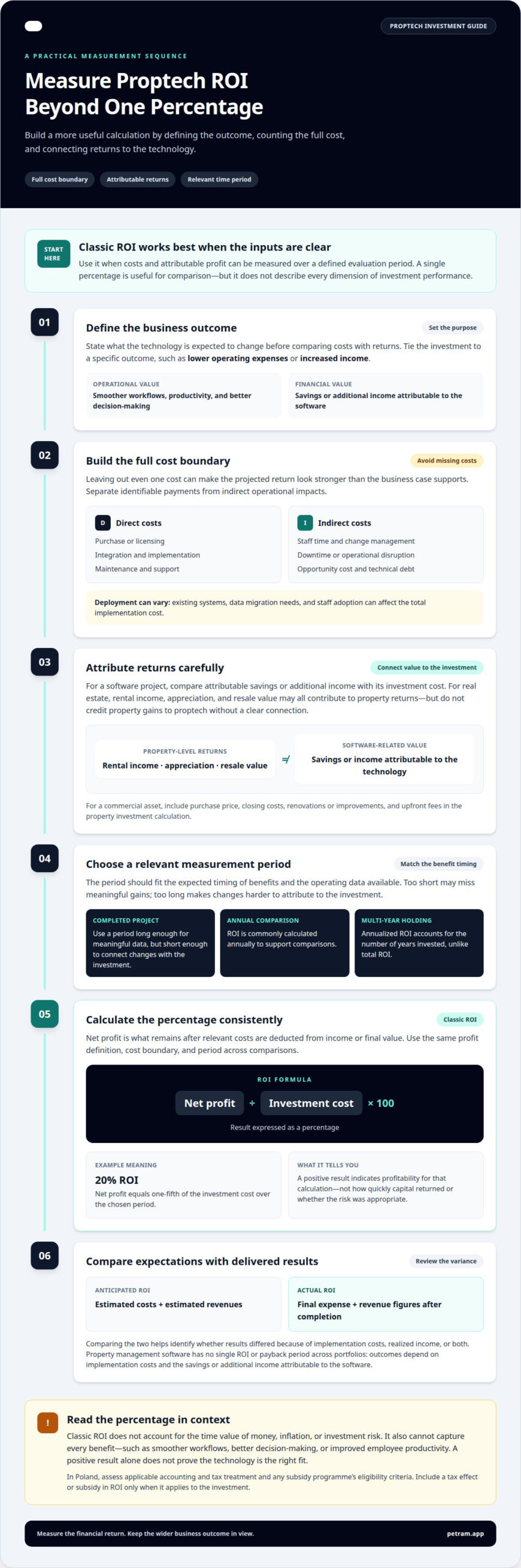
Investment costs are the direct and indirect resources committed to achieve expected returns. This matters because leaving out even one cost can make the projected return look stronger than the business case supports. Include purchase or licensing, integration, implementation, maintenance and support, plus opportunity costs such as staff time diverted from other work. Tie these costs to a specific outcome, such as lower operating expenses or increased income.
Income, Costs, and Real Estate Gains
Real estate investment income can include rental income, while gains may include appreciation and resale value. Compare these returns with the full investment cost, since rental income alone does not capture property performance. For a commercial asset, include purchase price, closing costs, renovations or improvements, and upfront fees. For proptech, separate software-related value from property appreciation so the technology is not credited for unrelated gains.
In Poland, assess the applicable accounting and tax treatment for each cost, along with any subsidy programme’s eligibility criteria. The relevant treatment depends on the project structure and programme rules, so include a tax effect or subsidy in ROI only when it applies to the investment.
Typical proptech implementation costs in Poland depend on the selected software and the work required to deploy it. Build the estimate from licensing or purchase, integration, implementation, ongoing maintenance and support, and indirect costs such as downtime and change management. Existing systems, data migration needs and staff adoption can all affect the total.
Separate direct costs from indirect costs in the forecast. Direct costs are identifiable payments for the technology and its deployment; indirect costs include operational disruption, employee time and the opportunity cost of choosing this project over another. Technical debt from outdated or inefficient systems can also affect the investment case. Include these categories before comparing expected income with expenditure.
Distinguish anticipated ROI from actual ROI. The anticipated calculation uses estimated costs and revenues; actual ROI uses final expense and revenue figures after completion. This helps property teams compare expectations with delivered results and identify whether a variance came from implementation costs, realised income or both.
A standard formula is net profit divided by investment cost, multiplied by 100 to express ROI as a percentage. The calculation is only as useful as its inputs: use a consistent cost boundary, attribute income to the investment where appropriate, and state the measurement period. That creates a clearer basis for comparing business cases.
When classic ROI calculations are appropriate
Classic ROI works best when an investment has measurable costs, attributable profit and a defined evaluation period. It gives property teams a comparable percentage, but does not capture every dimension of investment performance.
Property management software has no single ROI or payback period across portfolios. Results depend on implementation costs and the savings or additional income attributable to the software.
Choosing a Calculation Period
A calculation period is the window used to compare investment costs with resulting profit. It matters because a period that is too short may miss meaningful gains, while an overly long one makes it harder to attribute changes to the investment. Choose a window that fits the expected timing of benefits and the operating data available.
For a completed project, compare actual results over a period long enough to produce meaningful data but short enough to connect changes with the investment. ROI is commonly calculated annually to support comparisons. For a multi-year holding, annualized ROI accounts for the number of years invested, unlike total ROI.
The ROI Formula and Percentage
Classic ROI is net profit divided by investment cost, multiplied by 100 to express the result as a percentage. The formula matters because it converts a profit figure into a measure that can be compared across investments with different capital requirements. Keep the profit definition and period consistent across each comparison.
For example, a 20% ROI means the net profit equals one-fifth of the investment cost over the chosen period. A positive result indicates profitability for that calculation. It does not, by itself, show how quickly the investment returned capital or whether its risk was appropriate.
Calculating Net Profit and ROI
Net profit is what remains after the investment’s relevant costs are deducted from its income or final value. Use it as the numerator when calculating ROI, then divide by the investment cost. This matters because revenue alone can overstate profitability when expenses are omitted.
For a software project, compare attributable savings or additional income with its investment cost over the same period. Keep projected and actual calculations distinct: anticipated ROI uses estimates, while actual ROI uses final expense and revenue figures. This comparison shows where results differed from expectations.
ROI Calculation Examples
Consider an investment that generates net profit equal to one and a half times its cost. Its ROI is 150%, using the standard formula. The example shows why the numerator must be net profit, not gross revenue, and why a consistent cost boundary matters.
A real estate investment example produces 18% ROI over five years. Annualizing a multi-year result gives a different view: the formula is [(1 + ROI) raised to the power of 1/n, minus 1] multiplied by 100, where n is the number of years held. This supports clearer comparisons across different holding periods.
Classic ROI is most useful for discrete projects with identifiable financial outcomes. It does not account for the time value of money, inflation or investment risk. For long-term investments, pair the percentage with measures such as NPV, IRR or payback period to assess timing and cash-flow patterns.
Aligning technology investments with business goals
Technology ROI becomes meaningful when it connects software performance to a business priority. For commercial property teams, that starts with defining the outcome before selecting metrics.
Landlords can assess tenant experience and leasing technology using indicators such as inquiry response time, viewing-to-lease conversion, vacancy duration, renewal rates and tenant feedback. Compare these measures before and after implementation, then separate technology-related changes from market shifts or leasing policy changes.
Applying ROI to Technology Investments
Applying ROI to technology means comparing attributable business outcomes with the resources required to deliver them. Software performance alone does not show whether an investment advances a business priority. If the goal is faster leasing, track the time between a qualified inquiry and a signed lease, alongside leasing-team effort and resulting revenue.
Start with the property or business-unit priority, then identify the value driver behind it. For example, a goal of reducing repetitive administrative work calls for measures of staff time and process completion, not just a general satisfaction score. That connection helps decision-makers predict which operational changes should contribute to the expected return.
Tracking ROI Across the Technology Lifecycle
A lifecycle review assesses expected and realised value at key points, from selection through implementation and ongoing use. This matters because integration, adoption and changing workflows can shift costs or benefits after approval. Compare the original business case with observed performance, and record the reason for any material variance.
Use a consistent review structure: document the business priority, baseline, KPI, value driver and accountable business unit. During implementation, monitor delivery against the intended workflow change. After deployment, assess whether usage and operational results support the original expectations. If the property team changes its process, update the baseline or explain the change.
Reviewing ROI throughout the technology lifecycle also informs decisions about continued investment. A platform may meet initial performance expectations while new requirements change its value. Compare recurring costs with current outcomes, and identify whether adoption barriers, process redesign or changing customer expectations explain the gap.
Measuring Technology-Enabled ROI
Technology-enabled ROI measurement connects operational data and financial results to a digital change’s value proposition. This matters because outcomes such as tenant experience or employee productivity may appear before revenue effects. Track both leading indicators, such as response time, and lagging indicators, such as lease conversion or retention.
For a leasing workflow, compare inquiry handling and conversion before and after the change. For tenant experience, pair feedback with renewal patterns and service-related workload. These measures show whether improved interactions coincide with commercial outcomes, but do not establish causation on their own. Note other changes, including pricing, marketing and local demand, when interpreting results.
Keep the measurement practical: link each KPI to a business owner, a data source and a review point. A structured approach to commercial real estate technology planning can help teams keep those priorities connected to operational workflows.
Measuring investment impact through specific value propositions
A value proposition states the business outcome a technology investment is intended to create. For a commercial property portfolio, define that outcome first, then connect each KPI to a financial or operational effect.
For example, a tenant-experience platform may aim to support renewals, while leasing technology may aim to improve inquiry handling. Identify the affected value-chain activity, its baseline and the result that would demonstrate progress. This makes the investment case specific: rather than claiming technology improves service, track tenant feedback alongside renewal patterns.
KPIs should show both value creation and how it happens. Pair a financial measure, such as reduced operating costs or increased revenue, with an operational indicator, such as staff time spent on a process. Assign each metric a data source and responsible owner. Reviewing the measures together helps distinguish realised value from an improvement visible in only one part of the workflow.
Track tangible benefits, including reduced labour costs and increased income, alongside less direct gains in employee productivity, customer experience and decision-making. For example, if a digital workflow reduces manual work, measure the time released and assess whether teams redirect it to leasing or tenant support. A 10% increase in customer retention is one example of a variable that could improve ROI, but its relevance depends on the investment’s intended outcome.
Energy management and smart-building technologies can affect operating costs by changing energy use and supporting more informed building operations. Their effect on property value depends on whether the resulting cost profile, tenant appeal or income improves the asset’s expected performance. Track these effects separately rather than assuming installation creates value.
Initial expenses and future cash flows occur at different times, so a simple ROI percentage can obscure when benefits arrive. ROI does not account for the time value of money or inflation. For a project with continuing costs and benefits, assess the timing of each cash flow and the payback period alongside ROI. This gives decision-makers a clearer view of delayed savings compared with immediate expenditure.
Value realisation also requires comparing forecast and actual performance. Record the initial baseline, then review relevant KPIs after implementation and during ongoing use. If a property team expects lower energy expenses, compare consumption and related operating costs across comparable periods, while noting occupancy or operational changes that could influence the result.
For a portfolio decision, connect each technology investment to a specific business goal, such as retention, operating efficiency or revenue growth. Then compare forecast and realised cash flows, operational indicators and longer-term benefits. This disciplined approach helps leaders assess whether an investment delivers its intended value proposition, not merely whether the software is functioning.
ROI in commercial real estate
Commercial property ROI depends on which return you measure: property income, cash flow or operating profit relative to invested capital. For Polish portfolios, match the calculation to the decision, whether you are evaluating a purchase, financing structure, asset performance or proptech’s contribution.
Net operating income (NOI) is property revenue after operating expenses, but before debt service and taxes. It helps compare operating performance across assets without mixing financing costs into property operations. To calculate an indicative property-level return, divide NOI by total investment cost. One commercial real estate example produces an ROI of 9.2% using NOI and total investment, illustrating how the measure links operating performance to capital committed.
That calculation has limits. It does not show how much cash the investor personally contributed when debt finances a purchase. Cash-on-cash return instead divides annual cash flow after mortgage payments by the investor’s actual cash outlay, such as a down payment and fees. This is useful for evaluating financing choices, but excludes property value and long-term appreciation.
Return on invested capital answers a different question: how efficiently does the operation generate profit from committed capital? Calculate it by dividing net operating profit after tax by invested capital. Net operating profit after tax is operating income multiplied by one minus the tax rate. Keep this measure distinct from NOI, which is calculated before debt service and taxes.
Property ROI can also include rental income, appreciation and resale value relative to relevant costs, including purchase price, taxes and improvements. For an asset held over time, distinguish income received during ownership from any gain on resale. This avoids treating a future sale value as current operating performance and clarifies which assumptions drive a forecast.
Use comparable historical data to assess whether an asset is meeting its financial goals. Compare properties with similar operating profiles, and keep the measurement period and cost boundaries consistent. Complete historical records from comparable investments can improve projections, while statistical analysis can help identify trends and patterns. Still, ROI projections cannot predict future performance with certainty, and ROI itself does not account for investment risk or the possibility of loss.
For proptech decisions, separate property-level returns from technology-enabled effects. A change in NOI may reflect rent, occupancy, operating expenses or broader market conditions, not software alone. Track the relevant operating drivers alongside the technology’s costs and intended outcomes. This helps avoid attributing unrelated asset appreciation or income changes to a digital investment.
Higher ROI often comes with higher risk in commercial real estate. Use ROI to compare opportunities and track financial goals, then assess financing, cash flow and operating assumptions separately. Explore commercial real estate software to connect portfolio operations with the performance measures behind those decisions.
Taxes affect ROI through costs and the tax rate used to calculate net operating profit after tax; the section gives no specific Polish regulations or subsidies affecting proptech investment.
Petram.app (Rezone): Property Manager Software (Rezone)
Petram.app provides Rezone, commercial property manager software designed for property owners and managers. The platform includes AI Agents to help streamline operations, so teams can connect digital workflows with portfolio priorities and the value propositions they are tracking.
Turn to Rezone when your ROI analysis points to operational workflows as an area for closer management. Its property management software and AI Agents support digital workflows for commercial real estate, helping teams assess how technology can contribute to day-to-day operations and broader business goals.
To explore whether Rezone fits your commercial property management priorities, visit Petram.app.
Turn ROI analysis into a stronger investment strategy
The next opportunity is to make each technology decision improve the next one. Treat measuring ROI of proptech investments as an ongoing learning process: capture what shaped the result, refine the assumptions behind future business cases, and use those insights to guide portfolio priorities. That turns ROI from a retrospective score into a practical decision tool.
For your next evaluation, connect the investment to a clearly owned business outcome and establish how progress will inform future decisions. If expected value starts to diverge from actual performance, use that signal to revisit adoption, workflows or the investment’s role in the wider portfolio. Consistent evaluation can help your team build a more disciplined approach to modernization.
Ready to explore how technology could support your commercial property priorities? Contact Petram.app (Rezone) to discuss proptech and take the next step with clarity.
Frequently Asked Questions
What Are the Limitations of ROI?
ROI reduces a complex investment to a percentage, so it can miss important differences between projects. It does not show how quickly returns arrive, account for risk or capture benefits such as better decision-making. For example, a software project may produce modest immediate savings while improving portfolio visibility over time. Pair ROI with cash-flow timing, operational indicators and risk assessment to understand the investment beyond one result.
What Is a Good ROI?
A good ROI meets the investment’s business objective and compares favourably with relevant alternatives. There is no single percentage for every commercial property decision: a short-term workflow improvement and a long-term portfolio transformation have different value profiles. Set a target based on expected outcomes, total costs, time horizon and risk. Then compare actual performance with that target rather than judging the result in isolation.
How is ROI calculated for proptech investments in real estate?
Calculate proptech ROI by dividing attributable net benefit by total investment cost, then multiplying by 100. For example, compare changes in operating expenses or leasing income against software, deployment and related costs. Use a baseline from before implementation, then isolate changes plausibly linked to the technology. Keep property-level returns, such as appreciation, separate unless the technology’s contribution can be identified; otherwise, the calculation may credit software for unrelated asset gains.
Which KPIs measure proptech investment returns?
Choose KPIs that reflect the investment’s purpose. For leasing technology, track inquiry-to-viewing progression, time to lease and leasing-team workload. For tenant-facing tools, consider renewal patterns, feedback and time spent resolving requests. For operational platforms, monitor process completion, administrative effort and relevant operating expenses. Pair leading indicators, such as workflow usage, with commercial outcomes. A KPI is useful when its definition, data source and accountable owner remain consistent.
How should proptech ROI account for implementation, integration, training, and maintenance costs?
Include each cost within the same investment boundary, even when it appears in a different budget or period. Record implementation and integration effort, staff training time, ongoing maintenance and support, and disruption during transition. Also account for internal staff time diverted from other work. For example, if teams maintain parallel workflows during rollout, include that effort in the business case. Comparing full costs with attributable benefits prevents an overly optimistic return estimate.
What risks can reduce proptech investment returns, including cybersecurity and adoption barriers?
Cybersecurity incidents can create recovery expenses, interrupt operations and weaken tenant or owner confidence. Adoption barriers can also suppress returns: employees may avoid a system that does not fit established workflows, while incomplete data can undermine reporting. Assess access management, data handling, integration dependencies and staff readiness as part of the investment case. Track actual usage and process outcomes after deployment; low adoption or operational disruption can delay expected efficiencies and reduce realised value.